Glenn Jackson
Manager, Corporate Communications
Town of Stouffville
glenn.jackson@townofws.ca


This is a comprehensive review of Stouffville’s ward structure to assess whether existing boundaries continue to provide equitable representation, reflect community growth, and meet the municipality’s long-term governance needs.
According to Town policy, a ward boundary review must be conducted after the conclusion of three municipal elections to recognize the impacts of growth and its implications on representation. The last ward boundary review was conducted in 2009; therefore, a new study had to be completed before next year’s election.
Therefore, over the last seven months, Town staff and consultants Watson and Associates Economists Ltd. conducted an in-depth study of the boundaries. This study involved research, community and stakeholder engagement and the development of options on how a new ward system could be laid out in Whitchurch-Stouffville.
On March 23, Council was presented with the new ward options. They choose a new system that had two ‘rural’ wards and four ‘urban’ wards.
Each new ‘rural’ ward is physically larger than its predecessor, with Ward One’s eastern boundary now being McCowan Road north of Vandorf Sideroad, and Highway 48 south of Vandorf Sideroad. Ward One now includes both Vandorf and Gormley.
Except for the Sleepy Hollow Estates, Ward Two now extends south from Davis Drive to Bethesda Sideroad. It now encompasses Ballantrae, Musselman’s Lake and Bloomington.
Some significant changes have been made in the Community of Stouffville, most notably the inclusion of Ward Three within the community’s boundaries. Ward Three had previously been in the Gormley area.
Ward Three is now east of the Tenth Line and south of Bloomington Sideroad. Over 5,700 people currently live in this area. However, it is expected to grow to over 11,400 people by 2030 due to new developments at the old flea market site and the new Lincolnville GO station area.
Wards Four, Five and Six are now almost perfect rectangles.
Ward Four is now bounded by Highway 48, the Markham-Stouffville border, the Ninth Line and Bethesda Sideroad.
Ward Five is now bounded by the Ninth Line, Main Street, the Tenth Line and Bethesda Sideroad.
Ward Six is now bounded by the Ninth Line, the Markham-Stouffville border, the Tenth Line and Main Street.
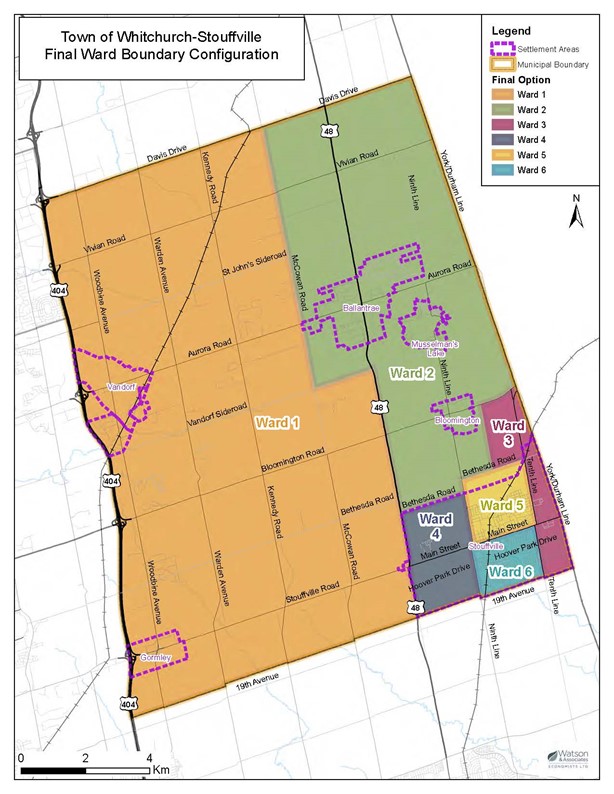
For complete descriptions of the new wards, download the full Ward Boundary Report. All ward boundaries become effective for the next municipal election in October 2022.
The project has a number of key objectives. The Review will:
There are no standard practices, terms of reference, criteria, or guiding principles either in provincial legislation or regulation, that can be used to evaluate the municipality’s electoral system. Instead, municipalities look to relevant Ontario Municipal Board (now the Local Planning Appeal Tribunal) decisions, case law such as Reference re Provincial Electoral Boundaries (Sask.), [1991] (“the Carter decision”) and best practices followed in other municipalities to establish appropriate guiding principles. The following guiding principles have been developed from such sources and will apply to the W.B.R. in Whitchurch-Stouffville.
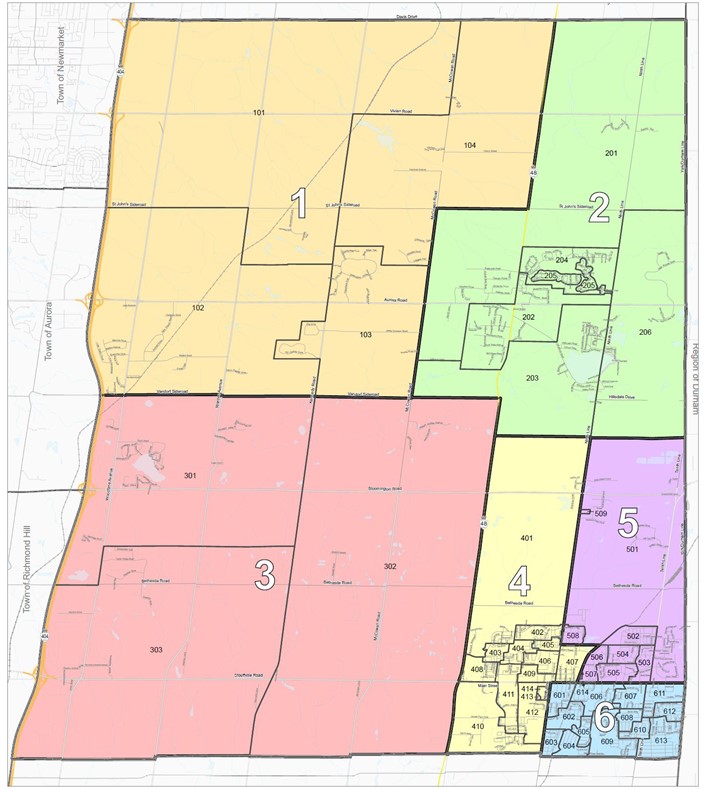
The primary objective of the W.B.R. is to evaluate the suitability of the present wards in terms of the guiding principles set out in section 3.3 of the Electoral Ward Boundary Review Policy and to develop alternative designs that are consistent with these principles.
The policy directs that, subject to the overriding principle of ‘effective representation,’ as set out in the 1991 Supreme Court of Canada ‘Carter decision,’ the following criteria will be referred to for guidance in the conduct of the review:
Communities of Interest
Future Population Trends
Physical and Natural Boundaries
Representation by Population
Effective Representation
Manager, Corporate Communications
Town of Stouffville
glenn.jackson@townofws.ca
Evaluating the operation of the current electoral structure and to determine what directions might be considered in developing ward boundaries
Evaluate the degree to which the current ward boundary configuration is effective and equitable based on the guiding principles
Following the format for Round 1, seek public perceptions of the preliminary alternatives based on a draft report. The input received from the consultation will inform the development of the alternative ward boundary options to be presented to Town Council
Conduct further analysis and evaluation of preliminary alternatives based on feedback, and finalize alternatives
Prepare a report that will present the finalized ward boundary alternatives, including recommended alternatives, which will be presented to Town Council. Once Council has made its decision, a final set of maps will be provided to the Town in support of the necessary by-law

111 Sandiford Drive, Stouffville ON, CA
customer.service@townofws.ca
(905) 640-1900
Accessible formats available upon request. Contact 905-640-1900 or customer.service@townofws.ca for assistance.
© 2024 Town of Whitchurch-Stouffville | Privacy and Disclaimer
